
How Long Does Hardwood Need to Acclimate Before Installing?
There's no fixed number of days. The common answer of 48 to 72 hours is a myth. Acclimation is the process of hardwood stabilizing its moisture content to match the home it's going into. That can take three days or three weeks depending on the season, the home's HVAC, how the wood was stored before delivery, and what the subfloor is reading.
If you try to install before acclimation is complete, you'll see gaps in winter and cupping in humid months. The boards won't fit the way you planned. You can't rush this, and you can't guess when it's done. Real acclimation means measuring, not watching the calendar.
What changes during acclimation
Hardwood is hygroscopic. It absorbs or releases moisture to match the relative humidity of the air around it. When boards arrive at your home, they've been stored in a warehouse or truck, where the humidity might have been very different from your living space.
As the wood sits in the installation area, moisture migrates in or out of the boards. This changes their width and thickness slightly. A board that was 3.25 inches wide might become 3.27 inches during humid acclimation or shrink to 3.23 inches in dry conditions. That's a small change per board, but across a room full of planks, it matters for fit and how the floor will move seasonally.
The change takes time. The moisture has to penetrate from the outer surface toward the center of the plank. Thick boards take longer than thin boards. Wide planks take longer than narrow ones. Tight stacking slows the process; proper racking speeds it up.
What doesn't change: the color, the finish, the grain. Acclimation is purely about moisture content. Visually, the boards look the same at the start and end. That's why you can't tell by looking whether acclimation is finished.
Factors that change acclimation time in Roseburg
Douglas County's seasons matter. If hardwood arrives during the wet season, the wood will absorb moisture from the air and the subfloor until it reaches equilibrium. In spring and summer, that can take longer than in winter because the RH is often higher.
Newer homes or homes with wet-on-wet construction take longer. If the drywall, concrete, or plaster is still drying, humidity inside the home is elevated and acclimation slows.
Crawlspace conditions matter too. A home with a damp crawlspace has higher subfloor moisture and higher ambient humidity in the lower floors. Wood will acclimate to that higher moisture level, which is fine as long as we test and account for it in our mitigation plan.
HVAC operation changes the timeline. The home should be at normal living conditions: thermostat set to where you'll live day-to-day, not cranked to 85 degrees to speed things up. If you're heating the house to extreme temperatures or cooling it unnaturally, the acclimation readings won't reflect what the wood will experience once you settle into normal routines.
How to set up wood for proper acclimation
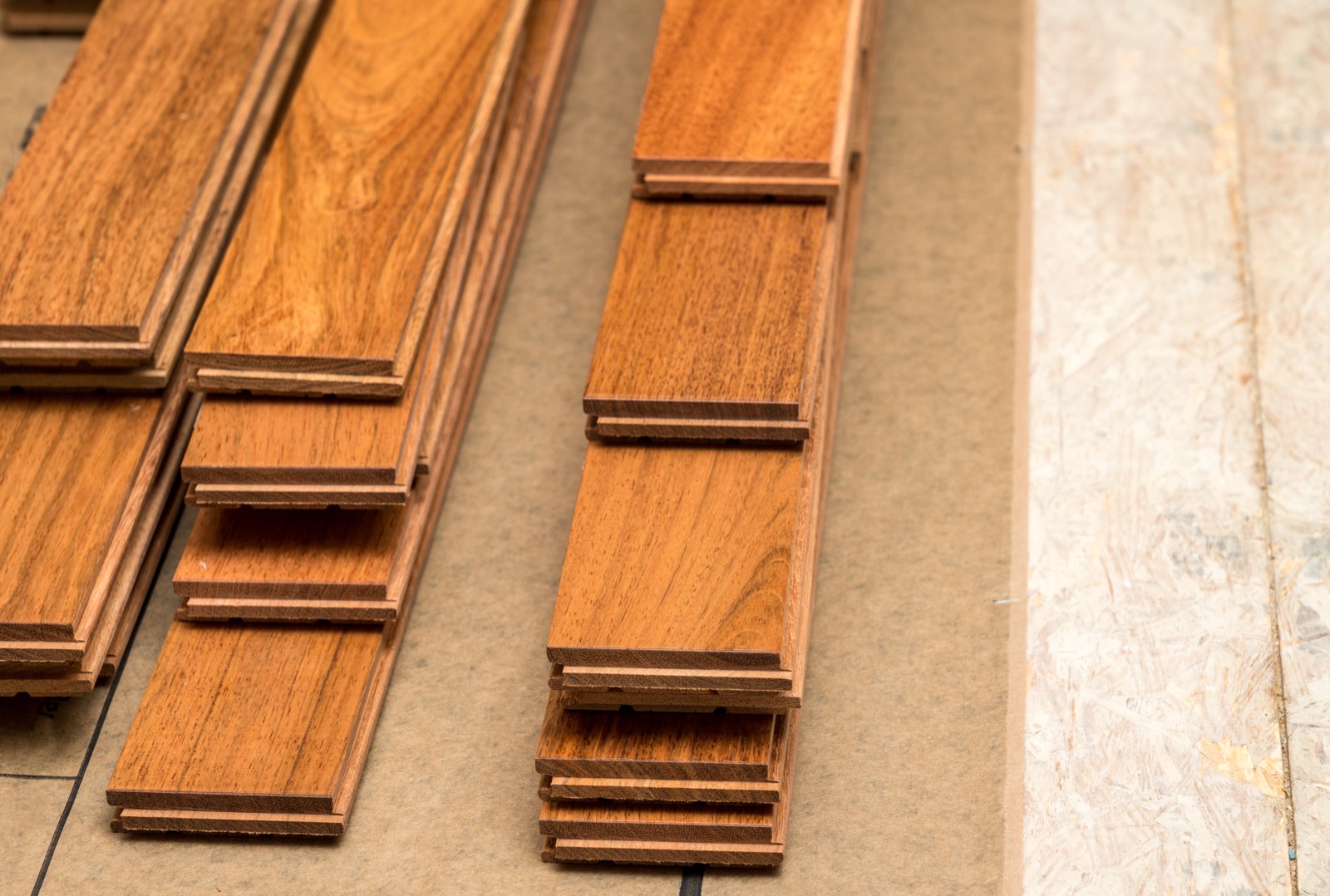
When the hardwood arrives, don't leave it in the boxes. Unopened bundles slow moisture exchange. Open the flooring and unstack it so air can circulate around all the boards.
Stand the boards on edge or lay them in cross-stacks (pieces alternating direction) so all four sides of each board are exposed to the air. Avoid laying boards flat in a single stack; the boards touching each other slow equalization.
Don't place flooring directly on concrete without a moisture break between them. Even if the concrete looks dry, moisture migrates upward. Lay down rosin paper or a slip sheet first.
Keep the installation area at normal living humidity. Close exterior doors and windows. Let the HVAC run at typical settings. Avoid space heaters, dehumidifiers, or extreme conditions that make the acclimation environment different from actual living conditions.
Leave the wood in the installation area for at least three days, but don't assume three days is enough. Wait for the moisture reading to stabilize.
How we know acclimation is complete
We use a moisture meter to measure the hardwood's moisture content at different points during the acclimation period. We take readings from boards in different cartons and from boards at different heights in the stack. We're looking for a stable trend, not a single good reading.
A stable trend means: readings from day one are 10% MC, day two is 9.5% MC, day three is 9.2% MC, day four is 9.2% MC. The wood is settling into a consistent level. That's different from: day one is 10%, day two is 8%, day three is 7% MC. That's still moving and not yet stable.
We also compare the hardwood's stabilized MC to the subfloor MC. If the subfloor is reading 8% and the hardwood is 9%, we're close enough. If the subfloor is 8% and the hardwood is still 12%, we wait longer or we implement drying measures.
Once readings are stable and within acceptable range of the subfloor, installation can proceed. That might be day 4 or day 14. The timeline depends on conditions, not on a calendar.
What happens if you skip acclimation
Hardwood installed before acclimation is complete moves after installation. In winter, as your home heats and dries out, the newly installed wood continues to shrink. Gaps open up between boards and along the perimeter. In some cases, gaps are wide enough to see the subfloor.
In humid months, the wood may continue to absorb moisture and swell. If it was already tight from installation, swelling creates pressure. Boards buckle, adhesive fails, or finish stress causes checking or cracking.
If boards were installed before the wood stabilized, you may also see squeaking, fastener popping, or subfloor sagging as the wood shrinks and fasteners lose their grip.
Acclimation and product choice
Solid hardwood typically requires the full acclimation protocol and benefits from longer stabilization time because of its density and thickness.
Engineered hardwood is more stable because of its cross-ply construction, which resists seasonal movement. But it still needs acclimation to the home's specific humidity. Even though engineered is less sensitive, we still measure and verify.
Wider planks are more sensitive to acclimation timing and require extra care. A 5-inch plank takes longer to stabilize than a 2.25-inch plank, and wide boards show movement more visibly if acclimation is skipped.
Planning your installation
When you schedule installation, build acclimation time into the timeline. Deliver the flooring at least a week before the planned install date. We'll measure the wood on arrival, take follow-up readings as it acclimates, and confirm the green light a day or two before we start.
The acclimation waiting period is not wasted time. It's the most important part of preventing gaps, cupping, and movement problems. If you're planning hardwood in Roseburg, schedule Back to the Wood Floors for an installation plan that includes delivery, acclimation milestones, and a measurement-based install start date. We'll make sure every board is ready before we lay the first plank.
Ready to transform your floors? Back to the Wood Floors has been serving Douglas County since 1990.
Get a Free Quote See Our Work