
Which Way Should Hardwood Planks Run?
The direction you choose for hardwood boards affects how the room looks, feels, and sounds. It influences perceived room size. It changes how light plays across the surface. It even impacts structural performance and squeaking over time.
Most homeowners think plank direction is purely aesthetic. It's not. The direction interacts with room shape, sightlines, light patterns, structural framing, and moisture stability. Getting it right requires thinking about both the look you want and how the floor will perform.
Direction changes how a room feels
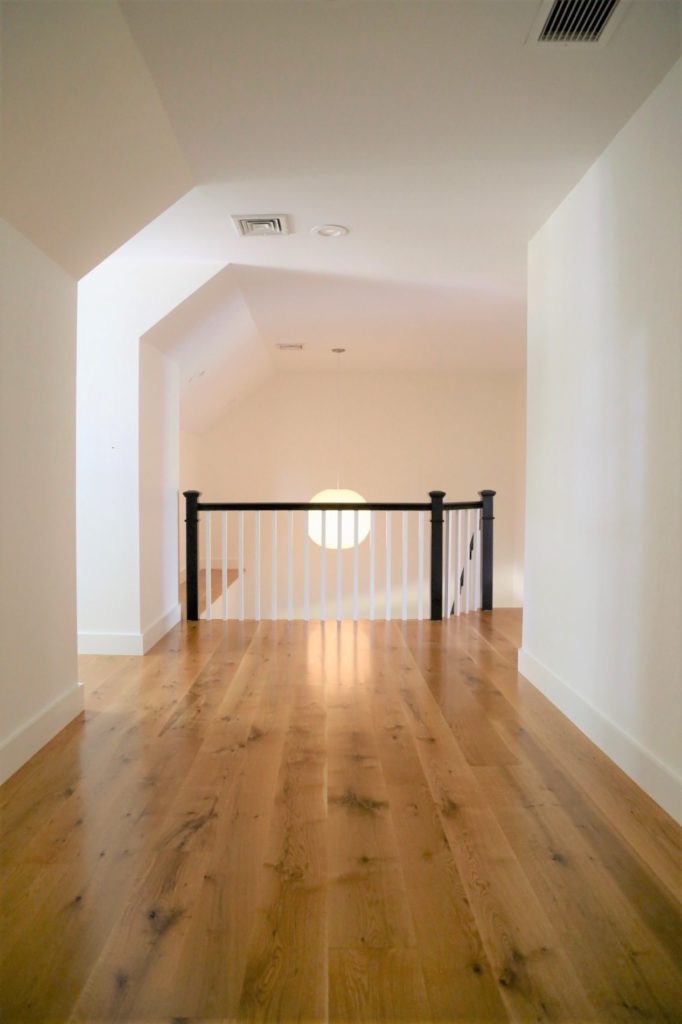
Stand at the primary entry to a room. Look in. The direction your eye naturally travels is the dominant sightline. Running hardwood planks parallel to that sightline creates visual flow and makes a narrow room feel longer.
Running planks perpendicular to a sightline breaks up space and can make a room feel wider. Diagonal layouts create movement and visual interest but also create more seams and require more cutting, which increases labor and material waste.
In open-concept homes where multiple rooms connect, consistency matters. Running boards the same direction through the living room, kitchen, and dining area creates a cohesive, calm feel. Changing direction at thresholds can work, but it requires careful transition planning and a clear reason for the shift.
How light changes what you see
Natural light that rakes across the floor at a low angle (morning and late afternoon sun) makes seams and minor height differences more visible. If you run planks perpendicular to incoming light, the light travels across board-to-board lines and emphasizes every seam.
Running planks parallel to incoming light softens the visual impact of seams. The light travels along the boards rather than across them, and small imperfections become less obvious.
Pay attention to where your main windows are and when the sun hits them hardest. Observe your space at different times of day. A room that looks clean and unified in the morning might show every seam at 4 p.m. when light comes in from the side.
This is just one factor, though. Light changes seasonally, and you'll experience the floor at many different times. Balance the light factor with other design and structural considerations.
Structural and performance factors
The direction of floor joists affects how much the floor deflects under load. Hardwood is usually installed perpendicular to joists for the most stiffness. Ask your installer to verify joist direction and confirm whether the chosen plank direction aligns with structural best practices for your subfloor.
Wider planks demand tighter tolerances and more support. If your home has older, widely-spaced joists or a subfloor that's marginal on flatness, narrower boards running perpendicular to the joists will perform better than wide planks running parallel.
Moisture stability is also affected by direction. In high-moisture environments (crawlspaces with humidity, bathrooms, kitchens near dishwashers), moisture tends to move with the grain. Running boards in a direction that promotes even moisture exposure can reduce cupping and edge-swelling.
Engineered hardwood offers more flexibility in direction than solid hardwood because the cross-ply construction resists moisture-related movement. If your home struggles with humidity control, engineered product gives you more design freedom.
Planning for transitions and seams
Seam stagger—the placement of end joints between rows—affects how busy or organized the floor looks. Random stagger creates a natural, less repetitive appearance. Repeating stagger patterns can look organized or, if too rigid, slightly institutional.
Butt joints (where board ends meet) are stronger than scarf joints, but they create visible seams. If you want to minimize seam visibility, run boards longer and plan fewer end joints per row.
Where hardwood meets other flooring (tile, carpet, different wood species) requires thought. A threshold or reducer transitions the height and finish. Planks should run in a way that looks intentional at these transitions, not like you ran out of space and had to change direction.
In hallways, kitchens, and bathrooms, seams across high-traffic lines wear faster and show dirt more readily. Consider running boards lengthwise through traffic paths to reduce the number of seams foot traffic crosses daily.
Layout options beyond basic direction
Beyond parallel, perpendicular, and diagonal, you can use feature strips, borders, or patterns. A feature strip or border in a contrasting wood species can define a room's perimeter and frame the center area. It's more labor-intensive but creates a high-end, intentional look.
Herringbone and chevron patterns use wood efficiently, create visual drama, and command attention. They also require more fitting, more fastening, and more precision. These patterns are beautiful but slower to install and more prone to gaps if the subfloor isn't perfectly flat.
Mixed widths—using boards of different widths in the same room—create organic, varied looks. They require planning to avoid chaotic appearance and tend to emphasize seams more than single-width floors.
Ask your installer whether they have experience with your preferred layout. Dry layout—arranging boards without fastening them first to test the look and confirm the seam pattern—is worth the time for complex designs.
Working with your installer on direction
The layout decision should be made before materials arrive and installation begins. Changing direction after the job has started is expensive and disruptive.
Walk the space with your installer at the pre-installation walkthrough. Stand at the primary entry sightline together. Note window locations and light patterns. Discuss whether the room will be furnished with a large rug or open, because furniture affects how much of the floor is actually visible.
Review how the chosen direction will look in adjacent rooms. A direction that works beautifully in the living room might look awkward if it fights the natural sightline in the hall or kitchen.
Ask for confirmation about seam stagger, starting wall position, and how transitions will be handled at doorways, stairs, and adjacent flooring. These details should be marked on the estimate or a written layout plan.
Your layout shapes the finished look
The direction you choose won't just affect how the floor looks when it's new. It influences how you'll perceive the room for the life of the installation. A well-planned direction feels natural and unified. A direction chosen without thought will feel off, even if you can't quite say why.
If you're planning hardwood floors in Roseburg and want to work through layout options before committing to a direction, Back to the Wood Floors can walk you through the considerations and create a plan that matches both your design goals and your home's structural conditions. Give us a call to schedule a layout consultation.
Ready to transform your floors? Back to the Wood Floors has been serving Douglas County since 1990.
Get a Free Quote See Our Work