
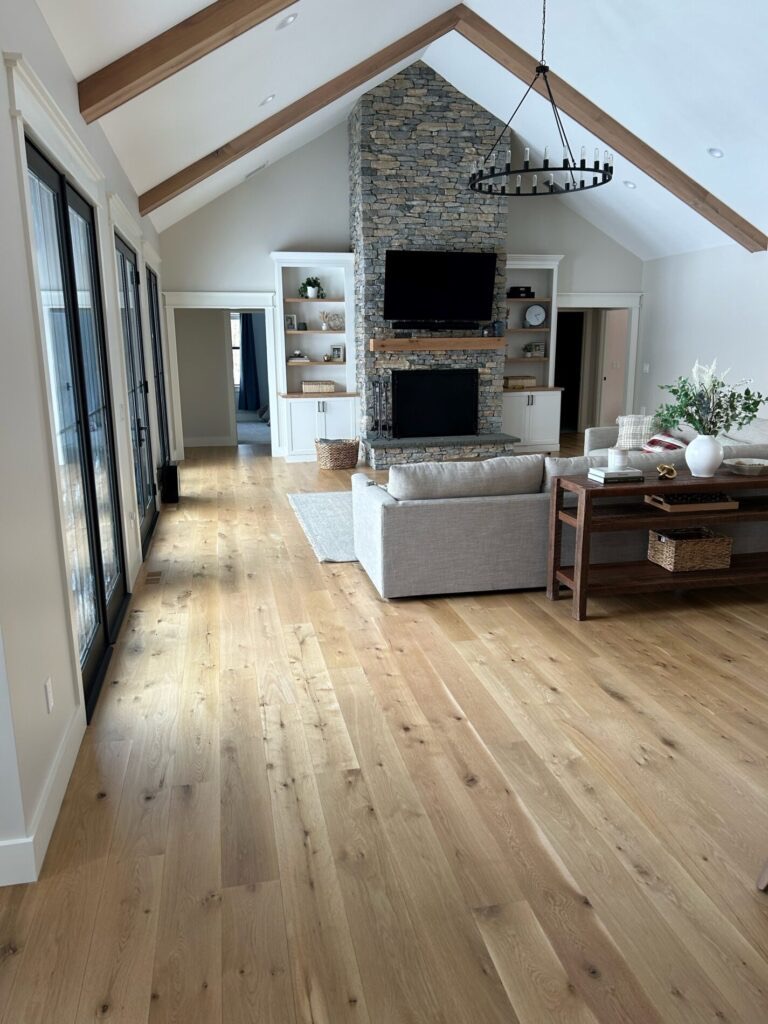
Why Wide Plank Hardwood Fails in Oregon Homes
Wide plank hardwood looks beautiful. A floor of eight-inch boards has an open, modern feel that narrow strip flooring cannot match. But in Oregon homes with damp crawlspaces and seasonal humidity swings, wide planks fail more often than narrow ones. The culprit is not the wood itself. It's moisture movement exaggerated across a wider surface.
A narrow three-quarter-inch strip floor can absorb or release 2-3% of its width when humidity shifts. A nine-inch wide plank releases that same percentage across a much larger distance. The mathematical difference is small, but the stress on fasteners and the visual gap is not. Add Oregon's wet winters and tight new homes, and wide planks become a moisture problem waiting to happen unless the installation is planned around it.
Why wide boards magnify moisture movement
Hardwood expands and contracts across the grain, not along the length. A change in moisture content of 5-6 percentage points is normal between Oregon's winter and summer. On a three-quarter-inch strip floor, that might create a barely noticeable 0.015-inch movement at the edge. On a nine-inch plank, the same moisture change can open a 0.5-inch gap or cause cupping that's visible to the eye.
The stress compounds at fasteners and glue lines. A wide board puts more shear force on each nail and more strain on each drop of adhesive. If the subfloor is not stable or if the fastening schedule is not adjusted for the extra width, boards start to fail: edges cup, end joints check and split, fasteners pop up, and the perimeter gaps grow to three-eighths of an inch or more.
Wide planks can work in Oregon. They just cannot work the same way they work in Arizona or Colorado. The moisture environment is different. The installation needs to acknowledge that.
Testing and acclimation: the foundation
Start with moisture testing weeks before installation. Use a calibrated moisture meter to measure the hardwood in its current packaging. Log readings from at least five planks from different parts of the pile. Do the same for the subfloor—multiple readings on plywood, OSB, or concrete depending on the system. Track indoor humidity for three to five days using a hygrometer, noting the lowest and highest readings.
Compare those numbers to the hardwood manufacturer's moisture content limits and to NWFA (National Wood Flooring Association) guidelines, typically 6-9% for hardwood in Oregon homes. If the wood is above 12%, the subfloor is above 14%, or the indoor environment is swinging wildly, work is needed before installation begins.
Acclimation is not letting boxes sit in the garage for 48 hours. True acclimation means the hardwood reaches equilibrium moisture content in your home's actual living conditions. Leave the boxes unopened initially, but turn on the HVAC system and let it run. After 24 hours, unpack boards carefully and lay them flat in the space, spread across the subfloor in a cross-hatch pattern so air circulates around all sides. Keep HVAC running continuously, not intermittently. After three to five days, re-test the wood. When readings match the subfloor and the indoor humidity, you're at equilibrium.
This takes longer in damp Douglas County winters than in dry climates. Plan for it. Never acclimate wood in a garage, basement, or unheated space. The moisture is wrong and the wood will equilibrate to the wrong level.
Subfloor flatness and underlayment selection
Professional wide-plank installation requires a subfloor that is flat within one-eighth of an inch over a ten-foot span. Use a straightedge and check in multiple directions. High spots need sanding or grinding. Low spots need backing screws or underlayment. Loose panels need refastening or replacement.
Flatness matters for two reasons: it keeps boards from rocking under foot traffic, and it ensures tongue-and-groove joints stay tight so moisture doesn't migrate through seams.
The underlayment and vapor retarder system depends on what's below the subfloor. Over a vented crawlspace, you need a system that allows some moisture transmission but controls capillary rise from the soil. Over a slab-on-grade, you need a moisture barrier that stops vapor, but not so tight that it traps moisture in the concrete and increases pressure under the floor. Wrong choice in either case creates the exact moisture imbalance that wide planks amplify.
Installation: fastening, glue, and layout
Wide planks often need glue-assist installation, meaning approved adhesives are applied along tongue grooves in addition to mechanical fastening. Check the manufacturer's specifications for which adhesives are approved. Wrong adhesive can void warranty or cause delamination. Right adhesive reduces movement and squeaks significantly.
The fastener schedule matters. Wider boards need more fasteners closer together, typically 8 inches apart instead of 10 or 12. Use screws instead of staples for wide boards in Douglas County crawlspace homes. Screws hold better in humidity cycling.
Plan the layout to avoid continuous seams running the full length of the room. Stagger end joints every third or fourth row, offset by at least 12 inches. This breaks up the stress pattern and reduces the chance of a wave forming across the floor.
Leave expansion gaps at the perimeter. Many installers stop at baseboard, but wood needs clearance to move. In wide-plank installations in moisture-prone areas, leave half an inch of space around the room and don't let baseboard pin the floor. The baseboard will cover it.
Common failures and what causes them
Cupping that won't go away points to moisture coming from below. The subfloor may be sitting on wet soil or a wet slab. The vapor retarder system is missing or wrong. The crawlspace is still venting moisture-laden air. Stop the moisture source first. Wide planks won't flatten until the subfloor is dry.
Gapping between boards that opens in winter and closes in spring is normal, though wide boards will show it more than narrow ones. Large gaps that grow and stay large suggest the boards were installed too dry. Acclimation was skipped or done in the wrong environment. The wood took on moisture and moved, but the fastening prevented it from moving uniformly, so edges opened up instead.
End splitting and checking at joints happens when wide boards dry too fast after installation or when humidity cycles are extreme. It also happens if the wood was installed without proper acclimation. Prevent it by controlling humidity and by giving the floor time to stabilize before turning on the heating system hard.
What to expect in a professional estimate
Before we order wide plank for a Douglas County home, we measure the subfloor, test its flatness, check moisture content in the wood and slab or crawlspace, log indoor humidity over several days, and assess the space for moisture sources like crawlspace vents or plumbing risk areas. We'll tell you whether wide plank is a good choice or whether the home needs extra moisture mitigation first. We provide a written moisture report and a plan that includes acclimation timeline, underlayment system, fastening schedule, and finish-cure conditions.
If your project needs wide plank and your home is in Douglas County, reach out to Back to the Wood Floors. We'll test the site, assess the moisture environment, and let you know whether we can deliver a floor that stays stable or whether we need to address the moisture conditions first.
Ready to transform your floors? Back to the Wood Floors has been serving Douglas County since 1990.
Get a Free Quote See Our Work